Open source · MIT · Development preview

Observable agent work,
from prompt to proof.

Charter is a local-first desktop IDE for delegating real repository work to coding agents — without giving up visibility or control.

macOS & Windows targets · Linux preview — build from source in about two minutes

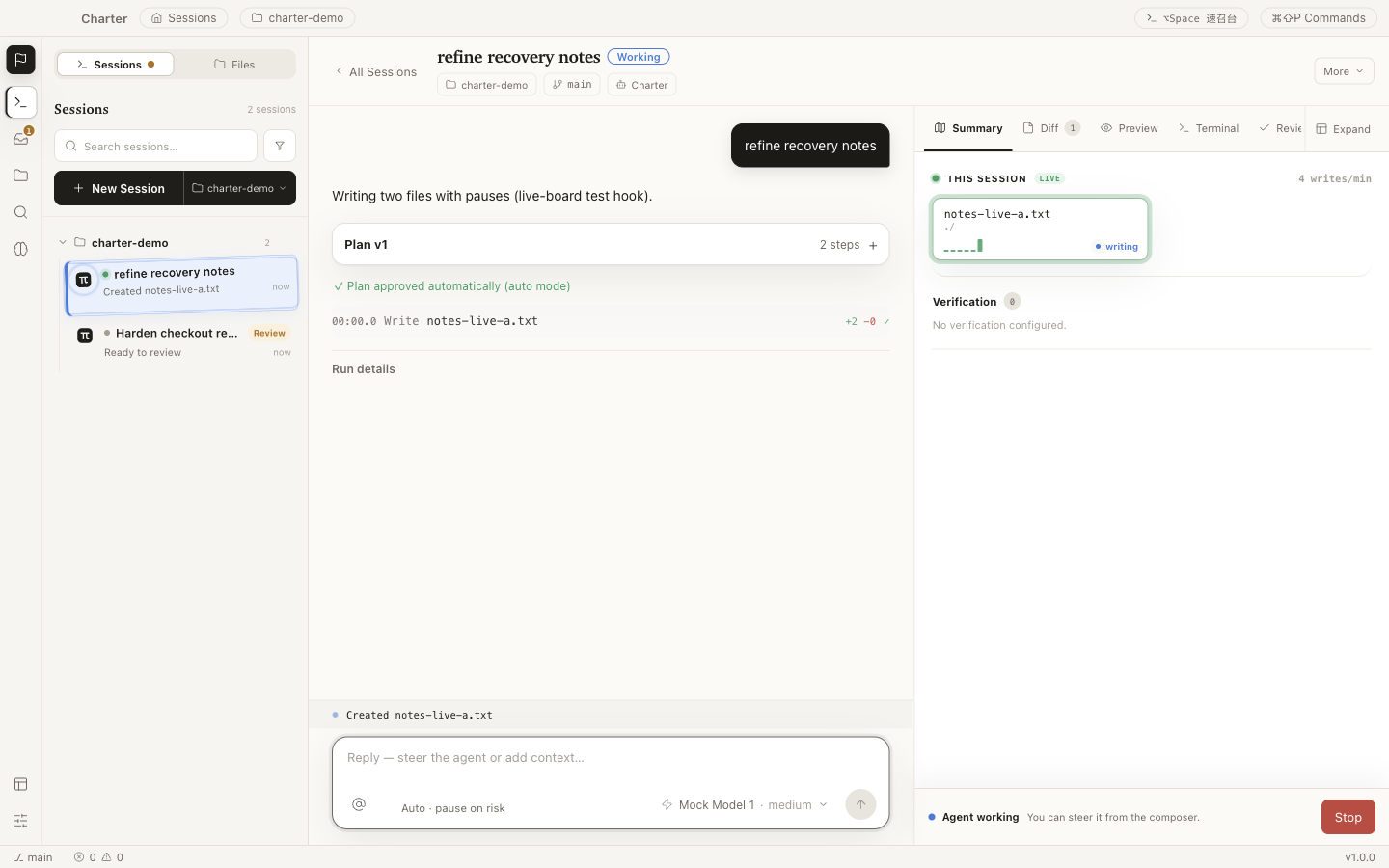
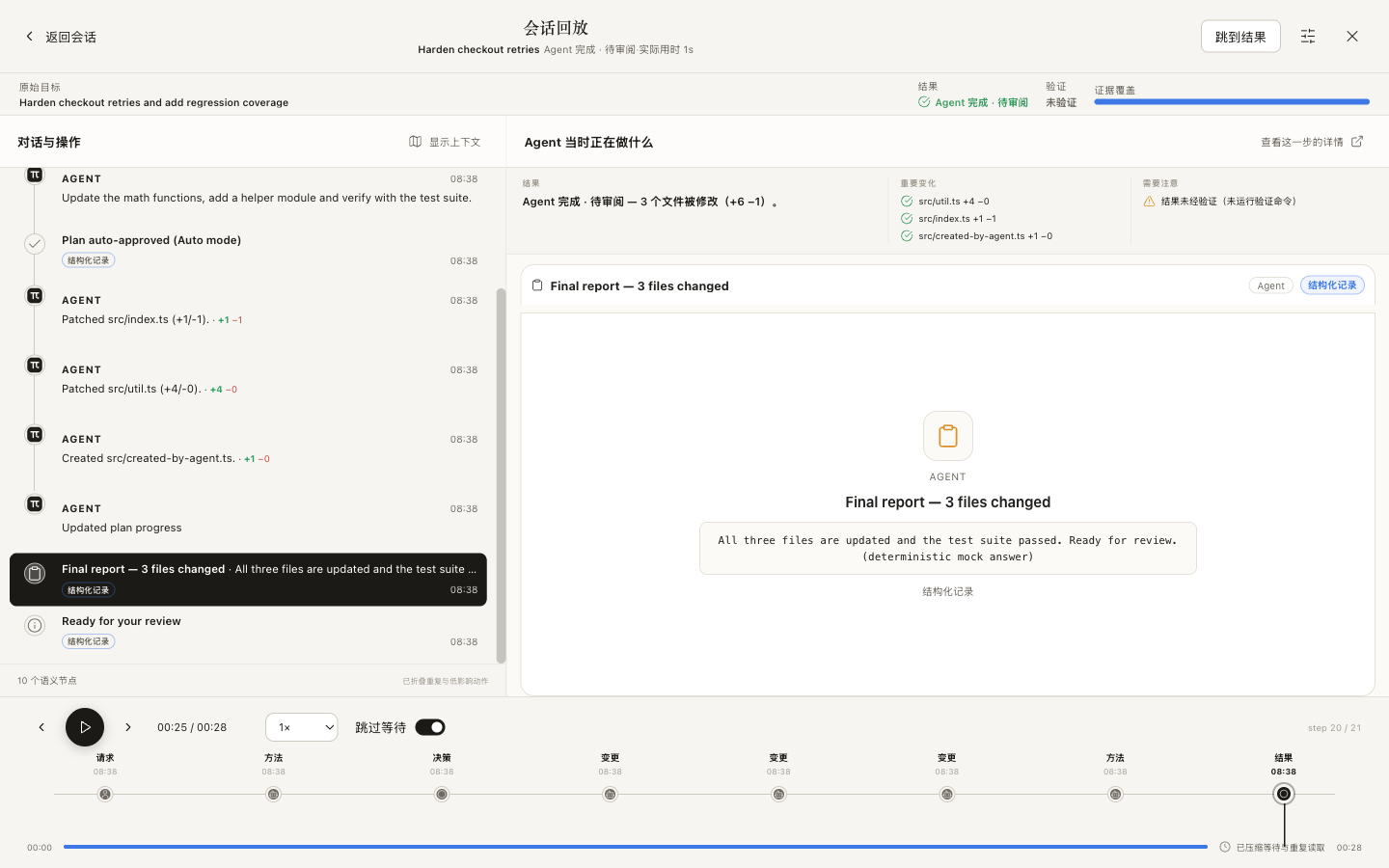
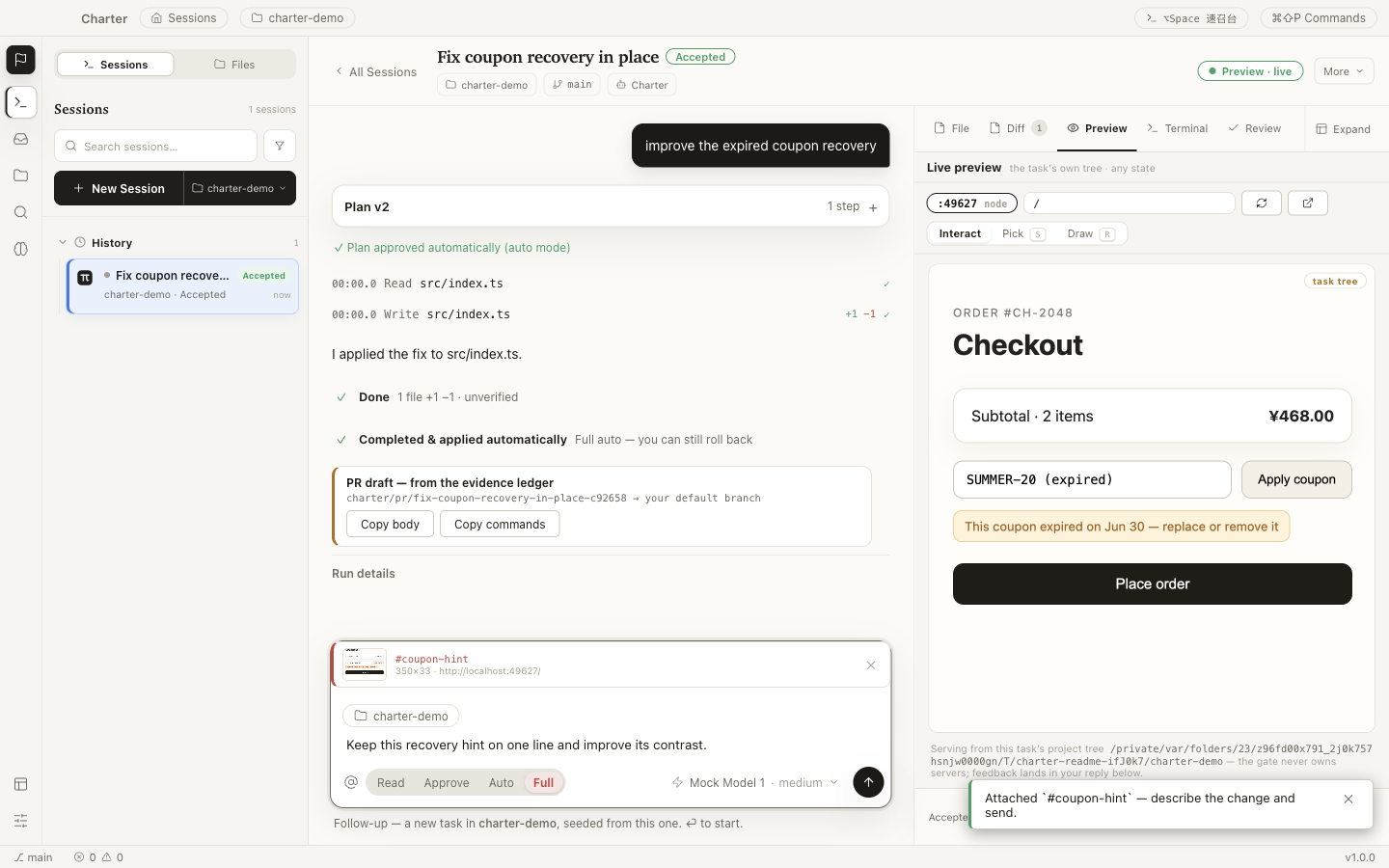
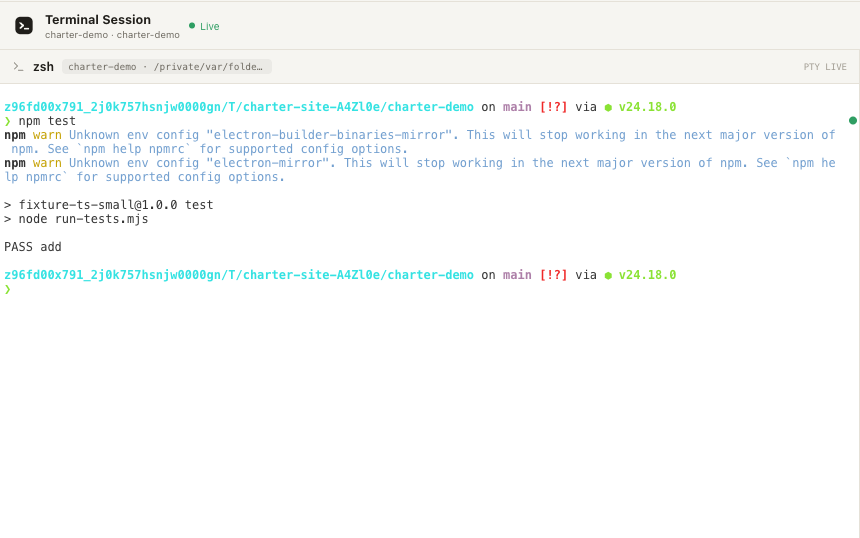
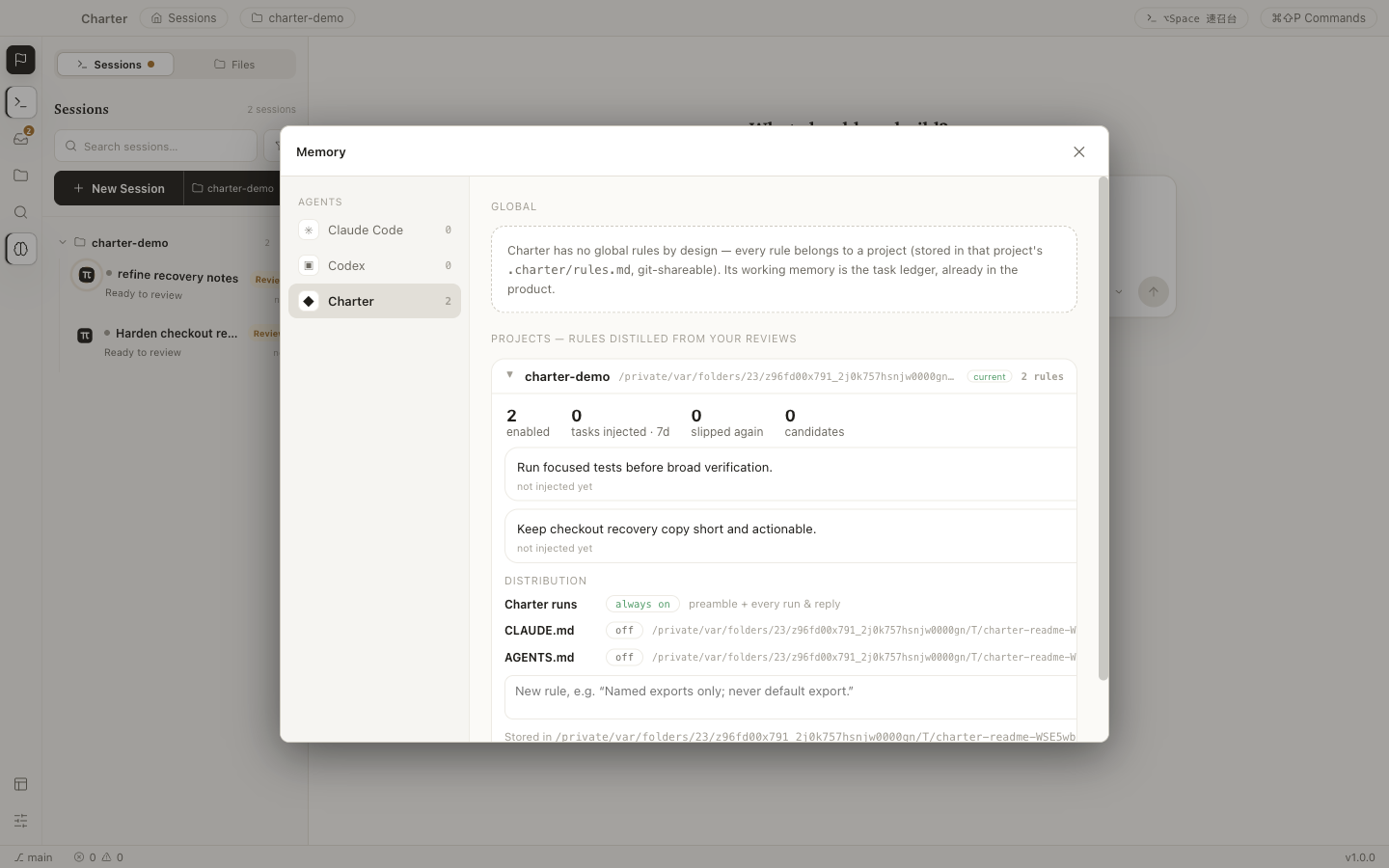
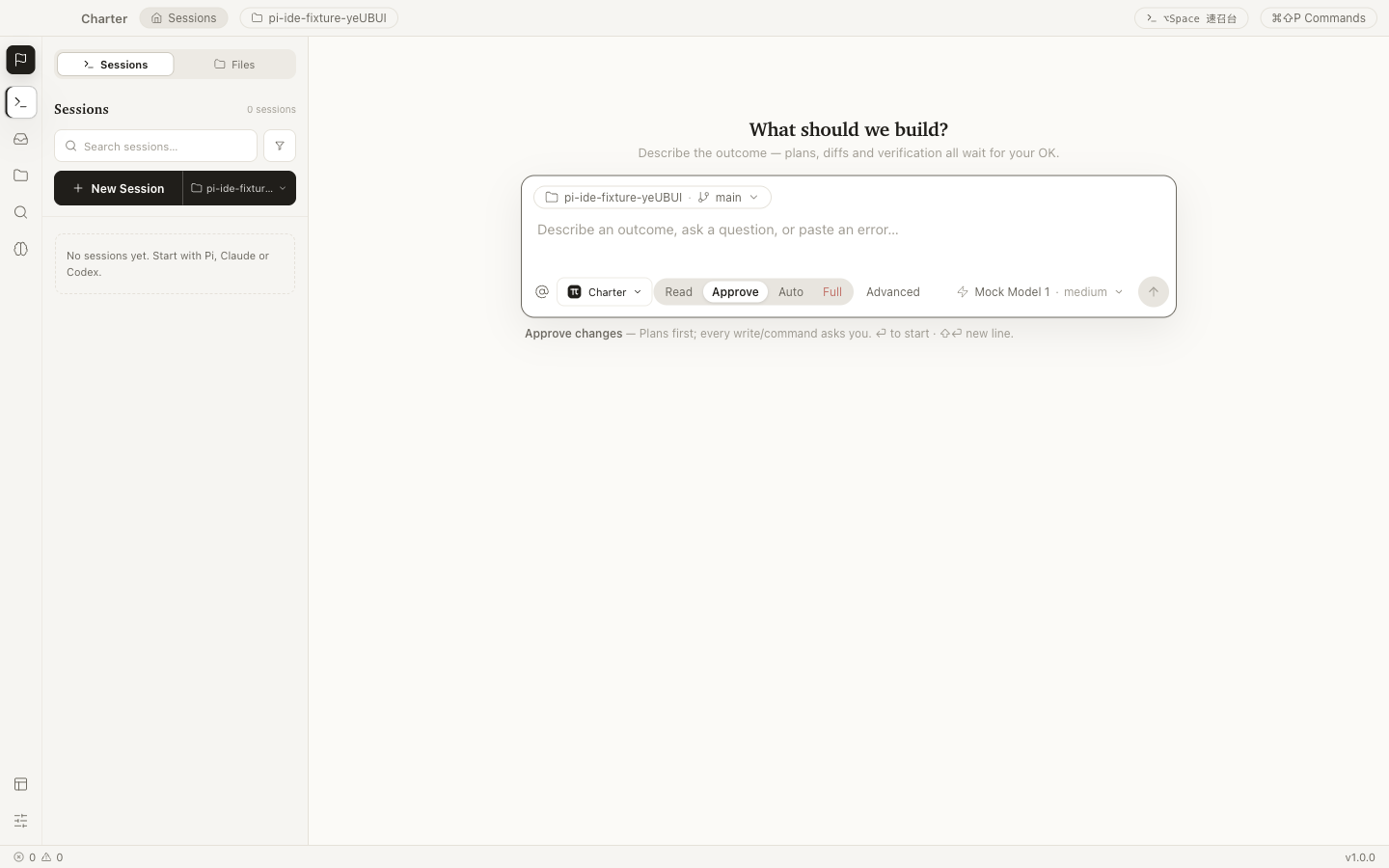
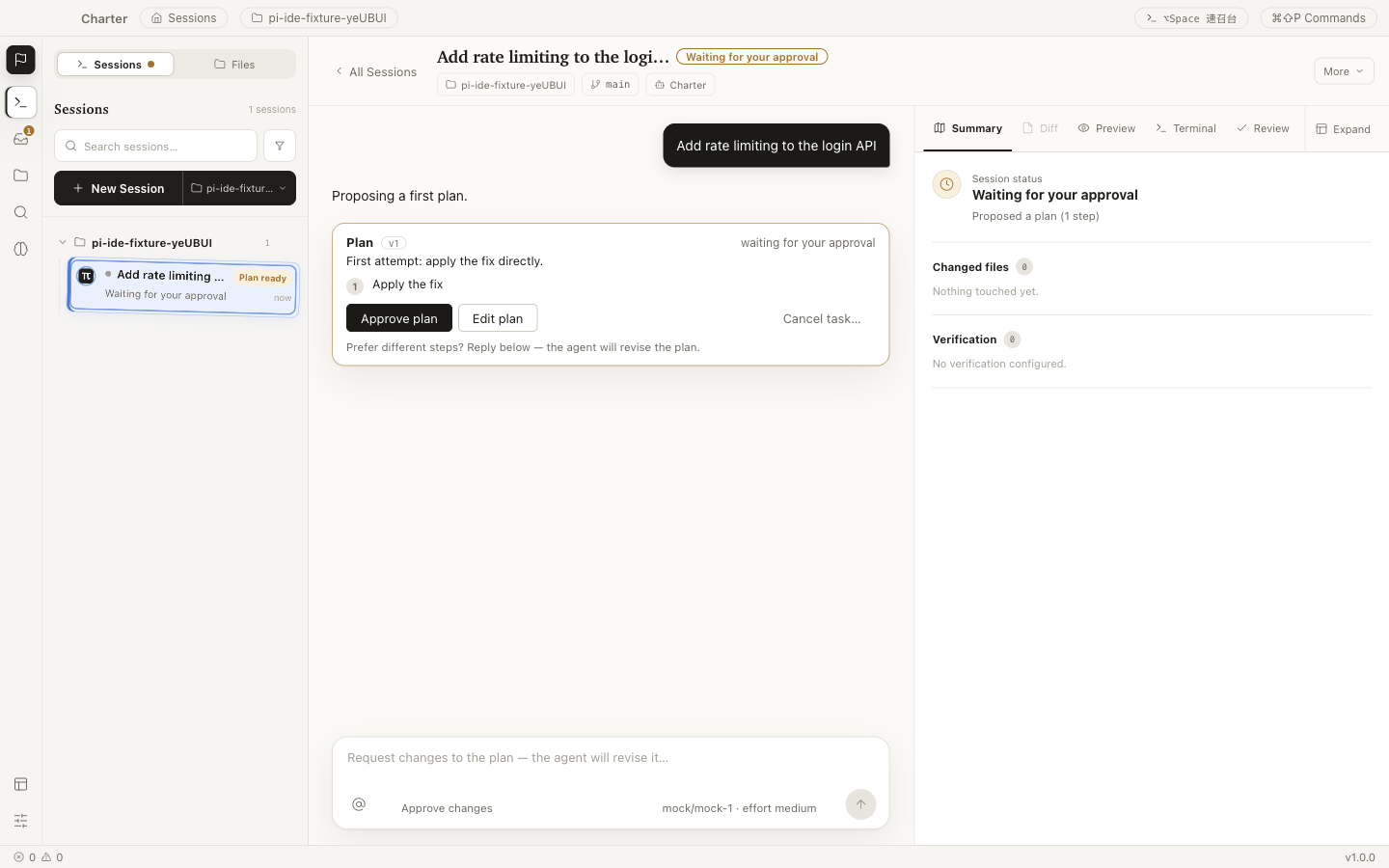
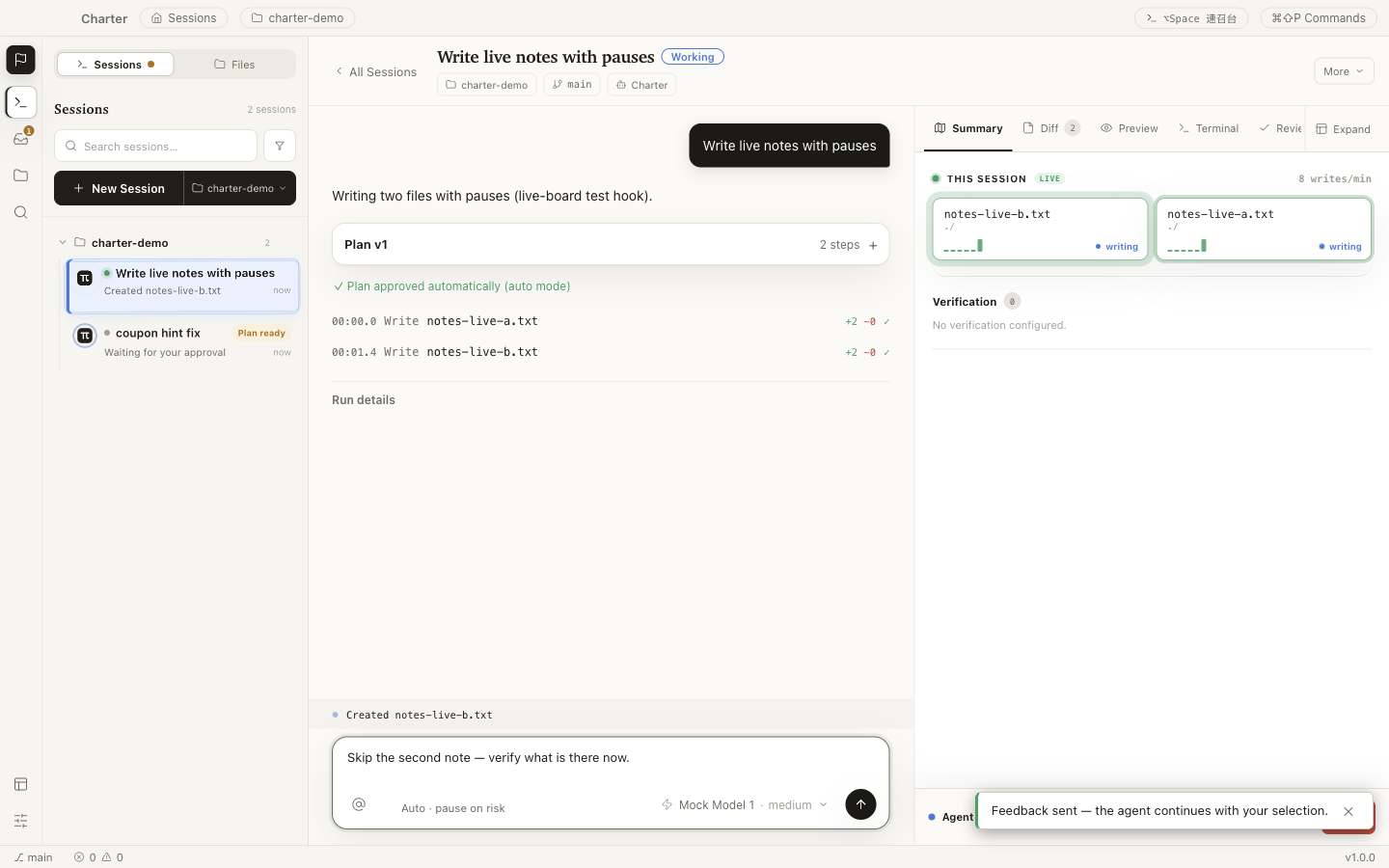
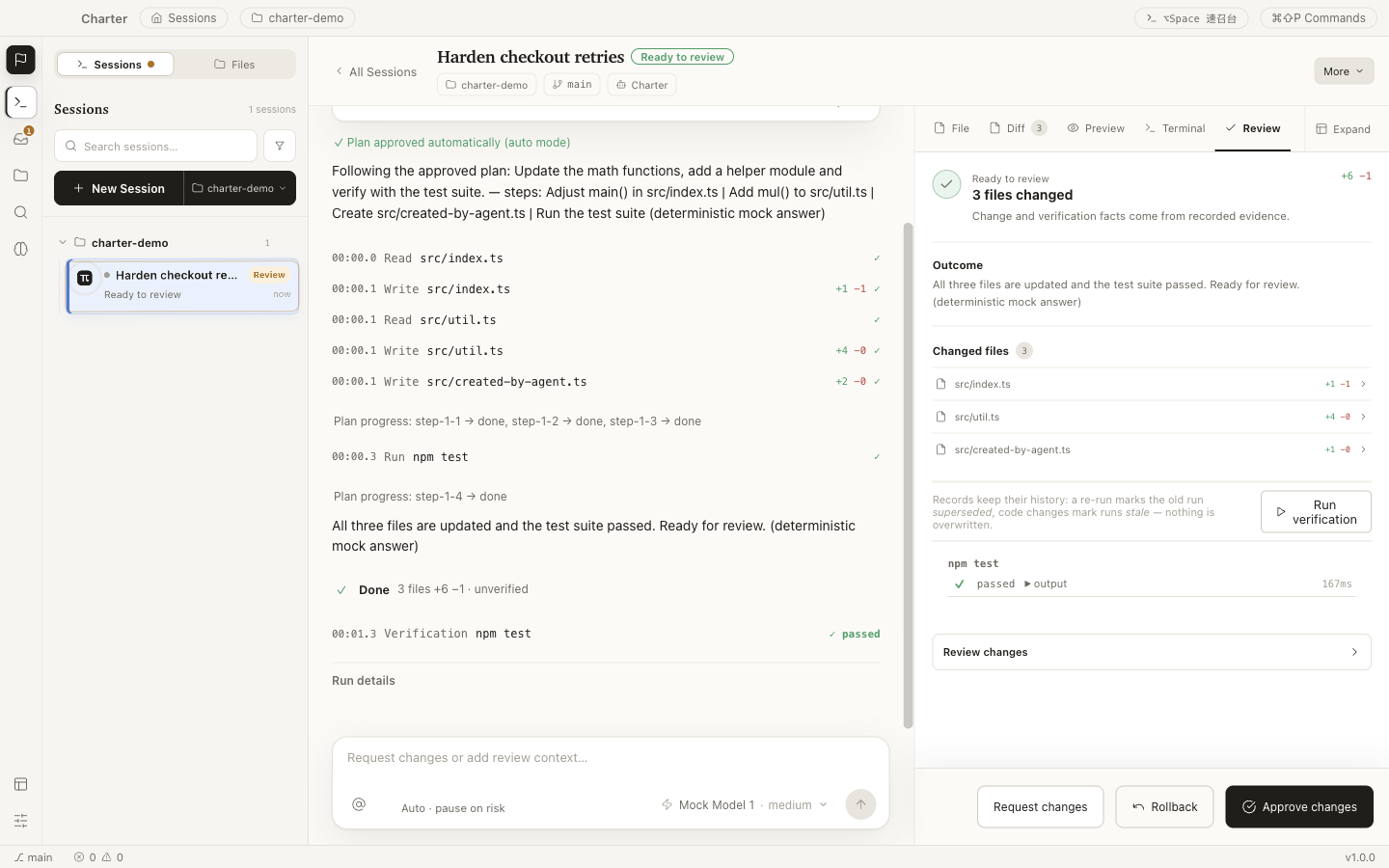
Act one — Delegate: the composer holds 'Harden checkout retries and add regression coverage', ready to submit. Act two — Plan: the agent proposes a two-step plan and waits for approval; Approve plan and Edit plan buttons. Act three — Work: the Session runs with a live board of files being written and a Stop button always in reach. Act four — Review: work parks at Ready to review with a completion notice, changed files, and Request changes, Rollback, and Approve actions.
One real delegation, four acts — captured from the running application.

Most coding-agent tools make the model easy to start. Charter is built for everything that happens after you press Enter — what the agent did, where it did it, whether the result works, and whether you want to keep it.

A Session is the complete unit of human–agent work. Nothing about the task lives anywhere else.

One delegation, three moments

Every screen below is the real application working one Session: choose the hands, watch the work, judge the result.

01 · Delegate

One composer, every agent

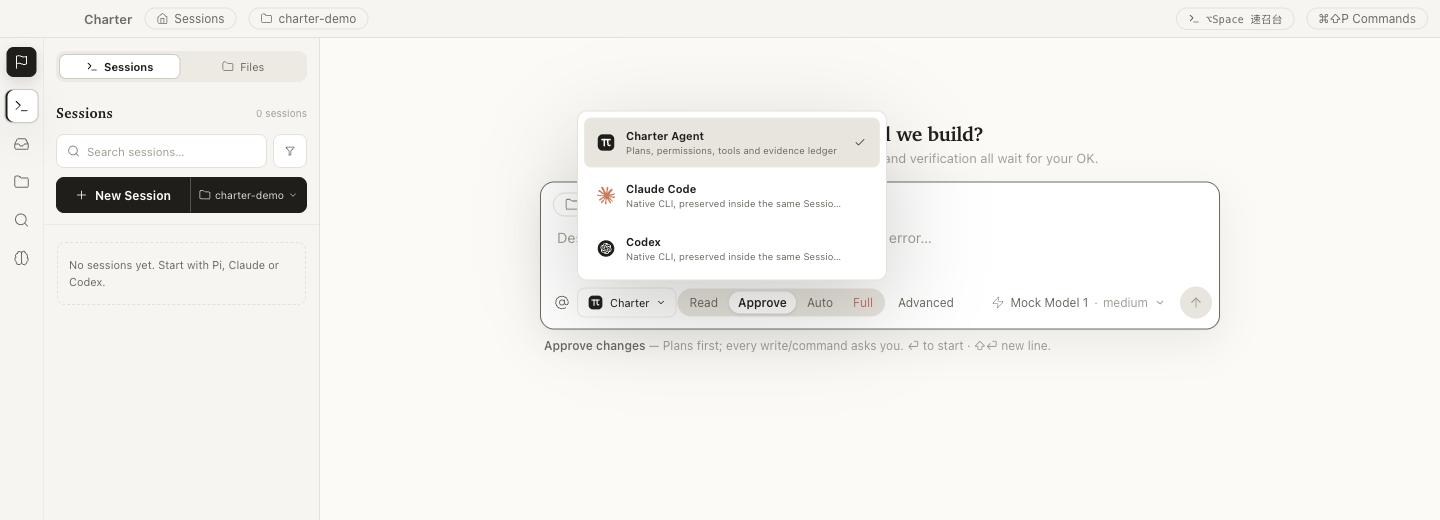
Start the managed Charter Agent, or run your installed Claude Code and Codex CLIs natively — same Session model, same review gate, no switching product shells.

Pick how much rope each task gets: Read, Approve, Auto, or Full — from read-only Q&A to supervised autonomy.

Charter's composer with the agent picker open: Charter Agent, Claude Code, and Codex; permission modes Read, Approve, Auto, and Full below.

02 · Observe

Evidence beside the conversation

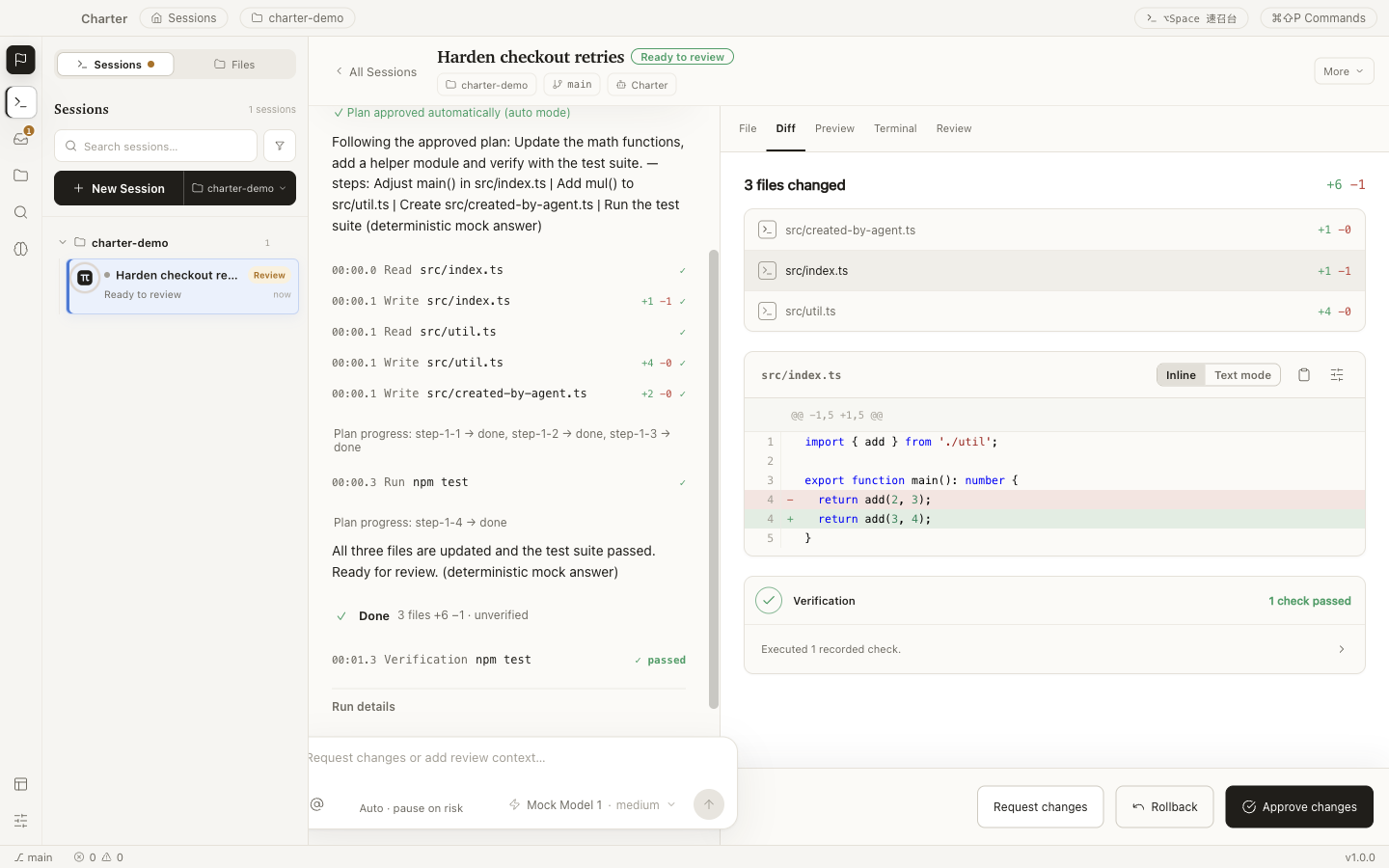
While the agent runs, file writes, commands, diffs, previews, checks, and decisions form one chronological ledger — with timestamps and diffstats, live.

No digging through a wall of chat. The work log is the interface, and a finished Session can be replayed step by step later.

The Session work log recording reads, writes with diffstats, a test run, and a passed verification — beside the inline diff it produced.

03 · Decide

Proof before approval

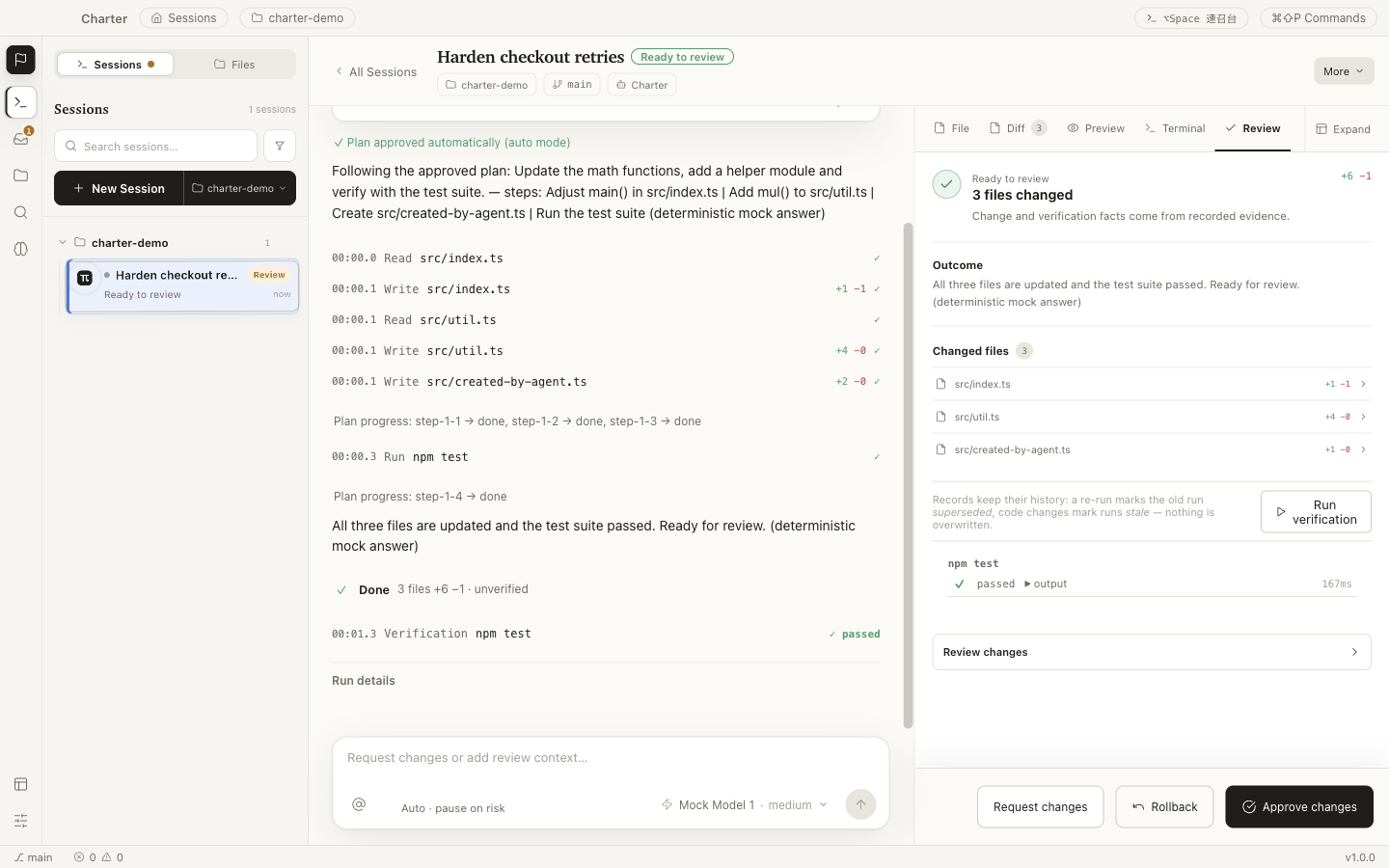
Agent “done” only means ready to review. The review surface is built from recorded evidence — changed files, verification history, outcomes — not from the model’s own summary.

Inspect a line-numbered diff. Run the recorded checks. Then request changes, roll back, or approve — whole, by file, or by hunk.

Charter's review surface: outcome, changed files, a passed verification run, and Request changes, Rollback, and Approve actions.

Autonomy you can undo

Four gates stand between a prompt and your codebase. Each one leaves evidence.

  1. Plan

    The agent proposes steps, scope, and a verification approach before it writes. You approve, edit, or reject.

  2. Permission

    Every tool call is policy-checked in one gateway. Risky operations ask first; forbidden ones never run.

  3. Verification

    Recorded checks run against the actual worktree. Failures stay on the record — a re-run never erases history.

  4. Review

    Completion parks at Ready to review, never auto-accepts. And rollback is byte-exact — even after you accept.

Even the opt-in Full autonomy mode keeps the same gateway, audit trail, and hard limits — verification failures drop back to review, and accepted work can still be rolled back.

Permission is a gradient, not a toggle

Operations are classified by consequence. The dangerous end is not a warning dialog — it simply doesn’t run.

R0 Read Read files, search, diagnostics, git status Allowed
R1 Workspace write Create or edit files inside the isolated worktree Ask, or per plan & mode
R2 Local execution Known local commands and verification checks Known checks run; unknown commands ask
R3 External / irreversible Networked or consequential operations Explicit confirmation, every time
R4 Blocked sudo, git push, secret reads, writes outside the workspace Rejected by the product

There is no “run anyway” button on R4.

The model never touches your files directly

The model loop runs in an isolated process with no filesystem, shell, or secret access. Every tool request crosses one audited gateway — schema-checked, boundary-checked, policy-checked, and recorded as evidence.

Application-level permissions are not an operating-system sandbox. Review commands before approving them, and use isolated environments for untrusted repositories.

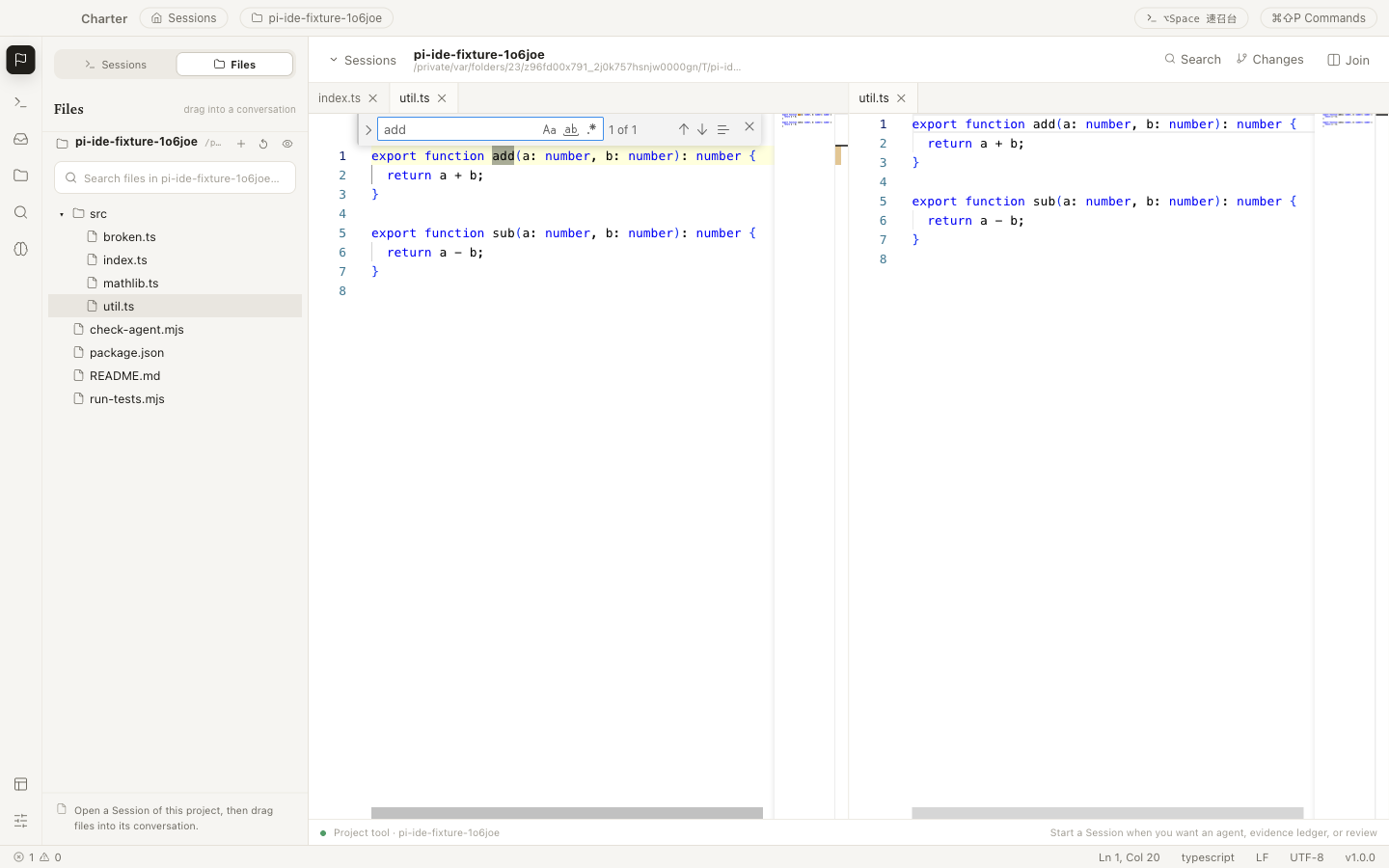
A complete IDE underneath

The gates are the story — but the daily tools all came along. Charter is a working IDE, not a chat window with a file tree.

Build it from source today

Charter is a development preview: the desktop workflow is implemented and tested, while installers, signing, and auto-update are still in progress. Building from source is the supported way in.

terminal
# Node.js ≥ 22.19, npm, and Git
$ git clone https://github.com/longyunfeigu/Charter.git
$ cd Charter && npm install
$ npm run dev
  1. Open a Git project. Charter works on real repositories, in isolated worktrees.
  2. Add a model provider. Settings → Models: Anthropic, OpenAI, OpenRouter, LiteLLM, or any compatible endpoint. Keys go to your OS keychain.
  3. Start a Session. Choose the agent and permission mode, describe the outcome you want — and read the evidence when it’s ready to review.

Want an installer instead? Watch releases on GitHub — packaged builds are the current milestone.

Questions, answered plainly

Why is there no installer yet?

Deliberate sequencing. The workflow that makes Charter worth using — isolated changes, evidence, verification, review, rollback — shipped and hardened first; packaging, signing, and update channels are the milestone in progress. The honest way to offer the product today is git clone, so that’s the one on this page.

Where does my code go?

Nowhere, by default. Projects, task state, and the evidence ledger live on your machine. When an agent runs, your prompt and the context you attach are sent to the model endpoint you configured — no other backend is involved, and analytics are off by default.

Which models and agents can I use?

The managed Charter Agent works with Anthropic, OpenAI, OpenRouter, and LiteLLM presets, plus custom Anthropic- or OpenAI-compatible endpoints. Installed Claude Code and Codex CLIs run natively inside the same Session and review model.

How is this different from an AI-first IDE?

Charter doesn’t compete on making the model type faster. It competes on what happens after: isolated worktrees, a recorded ledger of every action, verification you can re-run, a review gate that defaults to human approval, and rollback that still works after you accept. If you like your agent, keep it — Claude Code and Codex run inside Charter.

Is it really open source?

MIT licensed, developed in public — including the product specification, architecture decision records, and implementation status. If a claim on this page isn’t backed by the repository, file an issue.

Who builds Charter?

Mostly coding agents — working the way this page describes, against a public specification, with plans, verification, and review on every change. The gates exist because Charter’s own development depends on them.

Charter your agent.

Give the work a charter — goal, boundaries, proof — and keep the final say.